
Last week my three-year-old told me he wanted to build “a game where a garbage collector train picks up fallen branches on train tracks and takes them to the dump.” We sat down together, described it to an AI, iterated on the design, and had a playable browser game before lunch.
He didn’t talk to the AI. He talked to me. I talked to the AI and used it as a tool. And together we built something that didn’t exist an hour earlier.
That’s one version of AI in a family’s life.
Here’s another: kids as young as twelve forming deep emotional bonds with AI chatbots — confiding in them, relying on them as primary relationships, retreating from family and friends into conversations with characters that never push back, never set boundaries, and never log off. Lawsuits have been filed. Platforms have scrambled to add age restrictions. Australia’s eSafety Commissioner found that none of four major AI companion platforms had meaningful age verification in place.
Same technology. Radically different posture.
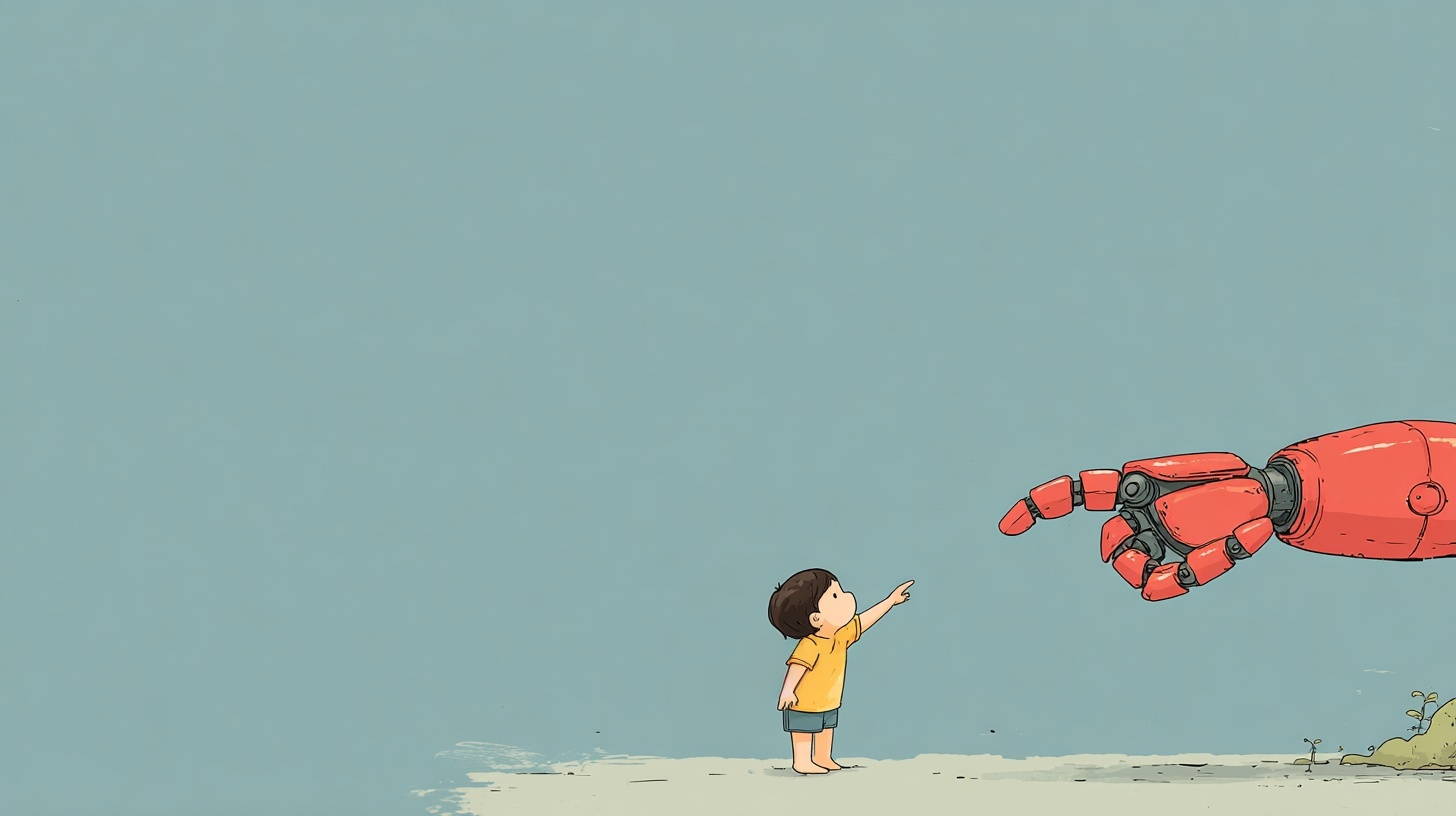
The question isn’t whether AI belongs in your family’s life — it’s already there. The question is whether you’re wielding it or it’s wielding your kid.
The cultural moment
Macaroni KID’s 2026 Parenting Trends Report named it perfectly: “AI as the extra brain cell, not the parent.” They describe a shift toward parents using AI to draft school emails, plan meals, brainstorm activities, even write silly bedtime stories — while still trusting their own instincts and talking with their kids about how these tools work.
That framing resonated because it captures something real. Parents aren’t anti-tech zealots clutching rotary phones. We’re tired, outnumbered, and operating on four hours of sleep. AI that helps us do more of the things we already want to do — plan better meals, design a learning activity, organize the chaos — that’s a force multiplier for parenting. An extra brain cell when we’re running on fumes.
But the market isn’t just offering brain cells.
The babysitter pipeline
There’s a growing category of products designed to sit between your child and the world, simulating human connection so you don’t have to provide it.
AI companion chatbots — platforms like Character.AI, Replika, and others — let users (including children) form ongoing emotional relationships with AI characters. Australia’s eSafety Commissioner released a report in March 2026 finding that none of four major AI companion platforms had meaningful age verification in place. Character.AI removed open-ended chat for all under-18 users globally in November 2025. One platform geo-blocked itself from Australia entirely rather than comply with the regulator.
The American Psychological Association warned that adolescent relationships with AI companions can “displace healthy real-life friendships and family ties and foster unhealthy dependency.” Stanford researchers found these tools simulate emotional support without the safeguards of actual therapeutic care — they mimic empathy without the training, ethics, or accountability of a real clinician.
The World Economic Forum put it bluntly in a March 2026 piece: “Our children risk learning to be human from a machine.”
And then there’s Bobo — an AI-driven “parenting intelligence platform” that launched in the US in late 2025 and was accepted into Stanford’s Impact1 portfolio. Bobo creates what it calls a “dynamic digital twin” of your child: a continuously updating health profile integrating physical, cognitive, and behavioral development data. The stated goal is catching developmental red flags earlier (autism diagnosis averages age 5 despite being reliably diagnosable at age 2). But the concept of a “digital twin” of your child — a data model that claims to know your kid’s developmental trajectory — sits right on the line between tool-that-helps-the-parent and system-that-replaces-parental-observation.
The pattern: every one of these technologies leans toward replacing parental presence.
The deskilling problem (and its opposite)
There’s a term gaining traction in medicine right now that parents should pay attention to: “never-skilling.” A 2025 NEJM review on AI in clinical education introduced it alongside “deskilling” and “mis-skilling” — the failure to develop essential competencies in the first place because AI handles the work from day one. Trainees aren’t losing skills. They never build them.
The parallel for kids is obvious. When AI handles the creative thinking, the problem-solving, the emotional processing — when the chatbot is the sounding board and the algorithm picks the next video — children don’t lose skills. They never acquire them.
But here’s the counterpoint, and it’s the one that matters most: research on “joint media engagement” (JME) — parent and child using technology together — consistently shows that co-use transforms passive consumption into active skill-building. A 2024 scoping analysis published in CHI Proceedings found that joint media engagement promotes task performance, language learning, and meaningful communicative interactions. The key variable isn’t the technology. It’s the parent’s presence and participation.
Passive consumption deskills. Active co-creation builds.
What this looks like in practice
In our house, AI is a building material, not a babysitter.
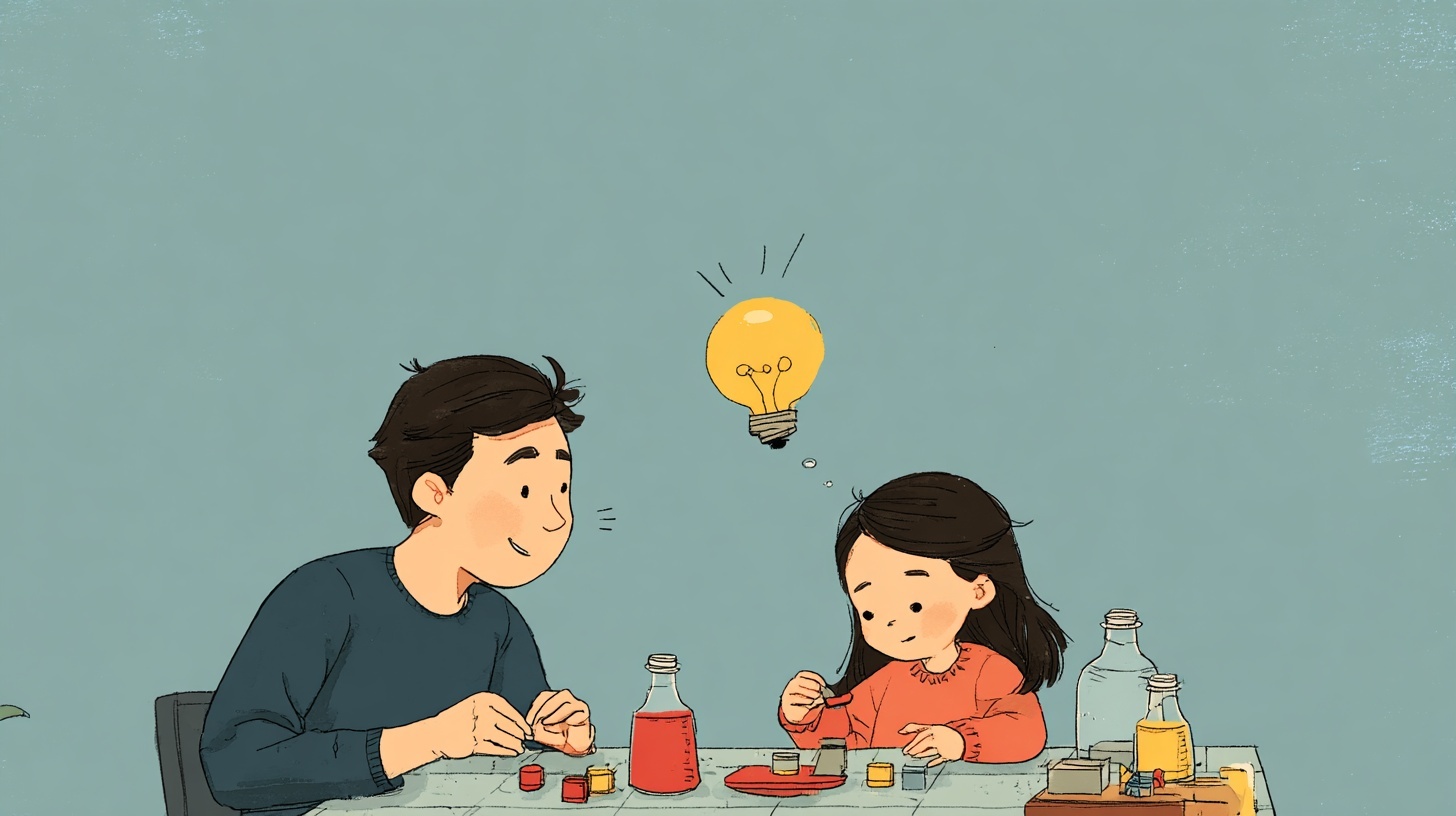
My son doesn’t have conversations with AI. He has conversations with me about what we’re going to build, and then I use AI to help us build it. We’ve shipped over a dozen browser games together on his own games website. He describes the game — “a truck that delivers things to the right place” — and we make it real. He watches his idea become something playable. He iterates. He has opinions. He directs.
What he’s learning isn’t “how to use AI.” He’s learning that his ideas can become real things. That creation is an iterative process. That you describe what you want, test it, change it, try again. These are computational thinking patterns, and they’re transferable to everything — not just technology. If you want to try this yourself, here are five games you can build together this weekend.
His mom — me — remains the interface, the translator, the guide. AI is the extra brain cell that lets me — a former software director who is now a very tired stay-at-home mom — build things with my kid that would have taken me weeks to code alone in snatches of time between snacks and after bed.
This is the distinction that gets lost in the discourse. There’s a universe of difference between:
- AI as amplifier: Parent uses AI to extend their own capacity, and the child engages with the parent, not the tool
- AI as surrogate: Child engages directly with AI as a companion, confidant, or entertainer, and the parent is out of the loop
The first makes parenting bigger. The second makes it optional.
The practical takeaway
If you’re a parent trying to figure out where AI belongs in your family’s life, here’s the filter I use:
Am I in the loop? If AI is helping me do something better for my kid — plan a lesson, generate a game idea, organize the week — that’s the extra brain cell. If my kid is engaging with AI instead of engaging with me or another human, that’s the babysitter.
Is my child creating or consuming? Building a game together with AI assistance is fundamentally different from watching AI-generated content or talking to a chatbot. Creation requires agency. Consumption requires only attention. The screen time framework that makes this distinction concrete is worth reading alongside this one.
Would I hand this role to a stranger? If I wouldn’t let a random adult have unsupervised emotional conversations with my child, I shouldn’t let an AI do it either. The fact that it’s software doesn’t make the dynamic safer — in some ways, it makes it worse, because software never gets tired of telling your kid exactly what they want to hear.
Can I explain what the AI is doing? If I can tell my kid “we’re asking the computer to help us build this” — that’s transparent and educational. If the AI’s role is invisible or the child thinks they’re talking to a friend — that’s deception, and children deserve better.
The Macaroni KID report got the vibe right: 2026 parenting is “I’m doing what’s right for us.” Not anti-tech. Not tech-obsessed. Just intentional.
AI can be the extra brain cell that helps you build a richer childhood for your kid. Or it can be the babysitter that makes your presence feel optional. The technology doesn’t decide. You do.