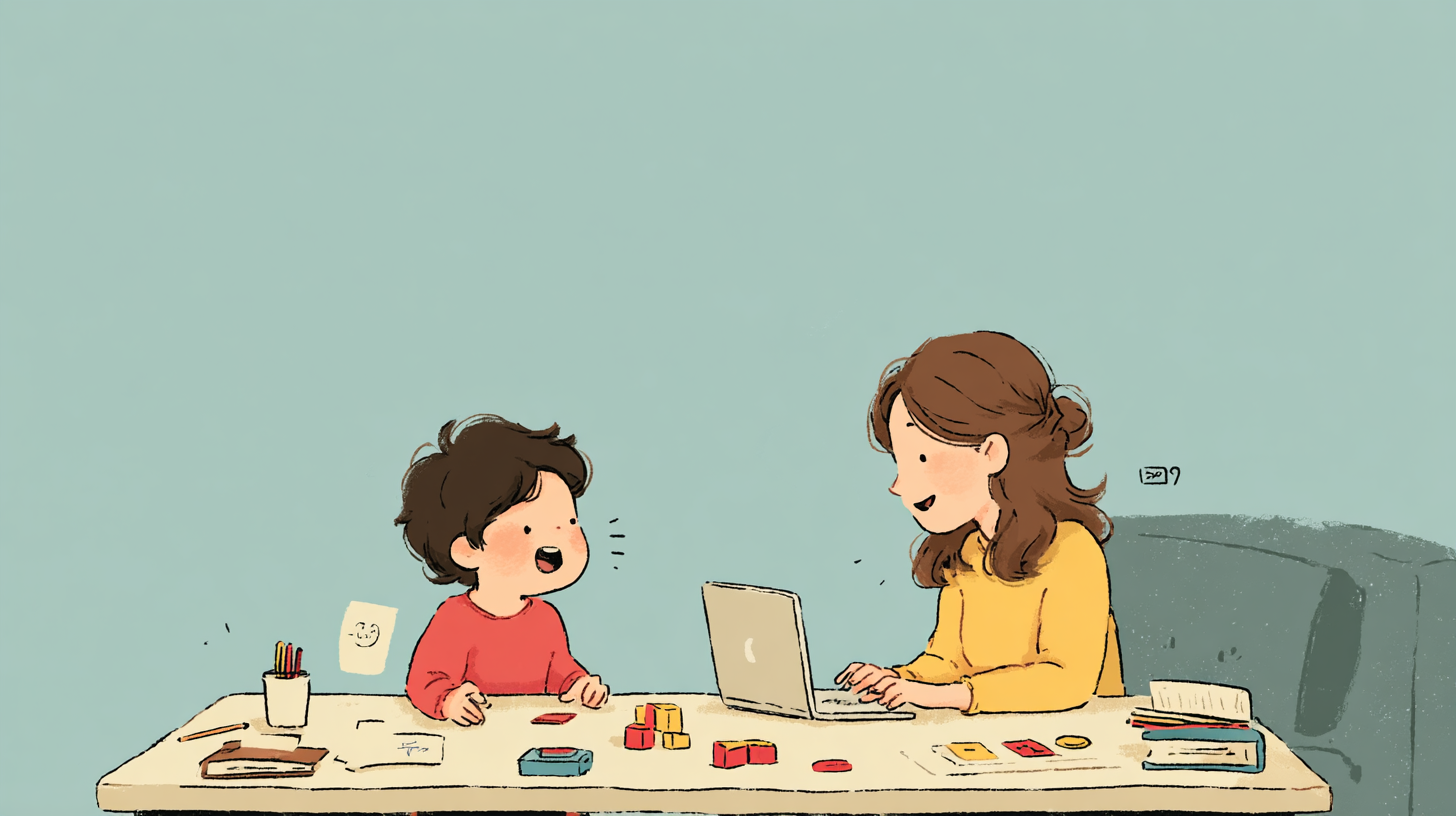

The screen time debate is asking the wrong question. “How much screen time should my toddler get?” treats all screen use as equal — but that’s silly. You wouldn’t tally “book time” because we recognize that all books are not equal. The thing worth asking instead: are they consuming or creating? Computational thinking only happens in one of those modes. Studies rarely distinguish between passive screen consumption and active, interactive work using screens, and the developmental outcomes are dramatically different.
Passive consumption — autoplay videos, dopamine-driven apps, unsupervised scrolling — is what the AAP guidelines and most screen time research are warning about. Active creation — building, designing, problem-solving with a parent present — barely shows up in the data at all. Not because it’s harmful, but because almost nobody is studying it. The two activities share a screen and nothing else.
So here’s the real question: is your kid consuming or creating?
What the Research Actually Says
The screen time studies that drive the scariest headlines are mostly studying television and passive video. A 2024 systematic review and meta-analysis in JAMA Pediatrics confirmed what earlier research suggested: the effects of screen time depend heavily on context — whether the engagement is passive or interactive, and whether an adult is co-viewing and mediating.
The American Academy of Pediatrics recommends no more than one hour of high-quality programming per day for children ages 2–5, with an emphasis on co-viewing. But these guidelines were designed around passive media. They don’t address a child who is actively directing what happens on screen — describing what they want, testing it, identifying problems, and iterating with a parent.
That’s not consumption. That’s creation. And collapsing the two into a single category called “screen time” is like collapsing vegetables and candy into “food time.”
What Screen Day Looks Like in Our House
My three-year-old has no screen time restrictions, but is never on screens alone. Instead, we’ve established screens and computer use as a tool for creation instead of consumption. Here’s what happens:
- He tells me what he wants to build. (“A jumping truck game where you get coins!”)
- I help him type his description into an AI tool like Claude or ChatGPT.
- A game appears. He plays it.
- He decides what to change. (“Make the coins bigger.” “Add a blue truck too.”)
- I type the changes. The game updates.
- We iterate until he’s satisfied or it’s time for a snack.
A typical session is 15–20 minutes. He’s not passively watching. He’s designing, testing, debugging, and making decisions. He’s exercising the exact cognitive skills — executive function, verbal reasoning, cause-and-effect thinking — that passive screen time has been shown to impair. Five examples of games we’ve built this way are worth trying if you want somewhere to start.
Most of his building time is screen-free: hands-on sorting games, block towers, conversations, exploring outside. Even without a computer, they all reinforce computational thinking concepts. For more on the AI-as-tool framework we use — and why there’s a universe of difference between AI as your extra brain cell and AI as a digital babysitter — that post goes deeper. If you’re interested in the structured version of our curriculum, I wrote it down for you.
The Variable Nobody Measures
The screen time conversation is missing the most important variable: agency.
Is your child choosing what happens, or is an algorithm choosing for them? Are they describing, testing, and revising — or are they swiping through an infinite feed someone else designed to hold their attention?
Here’s the framework I use instead of counting minutes:
Agency: Is the child making decisions, or is the app making decisions for them?
Co-regulation: Is a parent present, engaged, and talking about what’s happening?
Creation vs. consumption: Is the child planning or producing something, or only receiving?
Transfer: Does what he see on the screen connect to anything happening off screen?
A child building a game with a parent, then remixing it the next day, then teaching a new concept he’s learned to grandma on Friday — that’s a system where the screen serves the learning. Not the other way around.
Why the Guilt Is the Real Problem
Screen time guilt is a tax on thoughtful parents. It consumes cognitive bandwidth that could go toward asking better questions about what your child is doing, not how long they’re doing it.
The parents reading this aren’t the problem the research is warning about. You’re not handing your toddler an iPad and walking away. But the guilt you feel about twenty minutes of co-created, parent-mediated, purpose-driven screen use is real — and it’s counterproductive.
The 2025 Common Sense Census found that children ages 0-8 average about 2.5 hours of screen time per day — and 40% have their own tablet by age 2. Gaming time surged 65% in four years while traditional TV viewing declined. The issue isn’t the families who spend 20 intentional minutes building together. It’s the hours of unsupervised, passive consumption that fills the gap when parents don’t have better alternatives.
Stop counting minutes. Start asking what they made.A Better Framework for Toddler Screen Time
If you want a structure that resolves the guilt and replaces it with something useful, here’s ours:
Monday: Introduce a concept through hands-on, screen-free play. (Sorting toys, building block towers, following a recipe step by step.)
Tuesday: Explore the same concept deeper. More conversation, more physical play.
Wednesday: Build day. One screen session, 15–20 minutes, parent and child together. Use an AI tool to build a simple game based on the week’s concept.
Thursday: Remix the game. Change it, break it on purpose, fix it. This can be screen-based or not.
Friday: Teach the concept. Your child explains what they learned to someone — a parent, a sibling, a stuffed animal.
Weekend: Free play. Let it breathe.
One screen day. Four screen-free days. Twelve weeks of computational thinking concepts. That’s the system — and it’s what the 12-week curriculum is built around.