
Parents spend a lot of time worrying about whether a toddler can focus.
A more useful question is whether the environment allows them to.
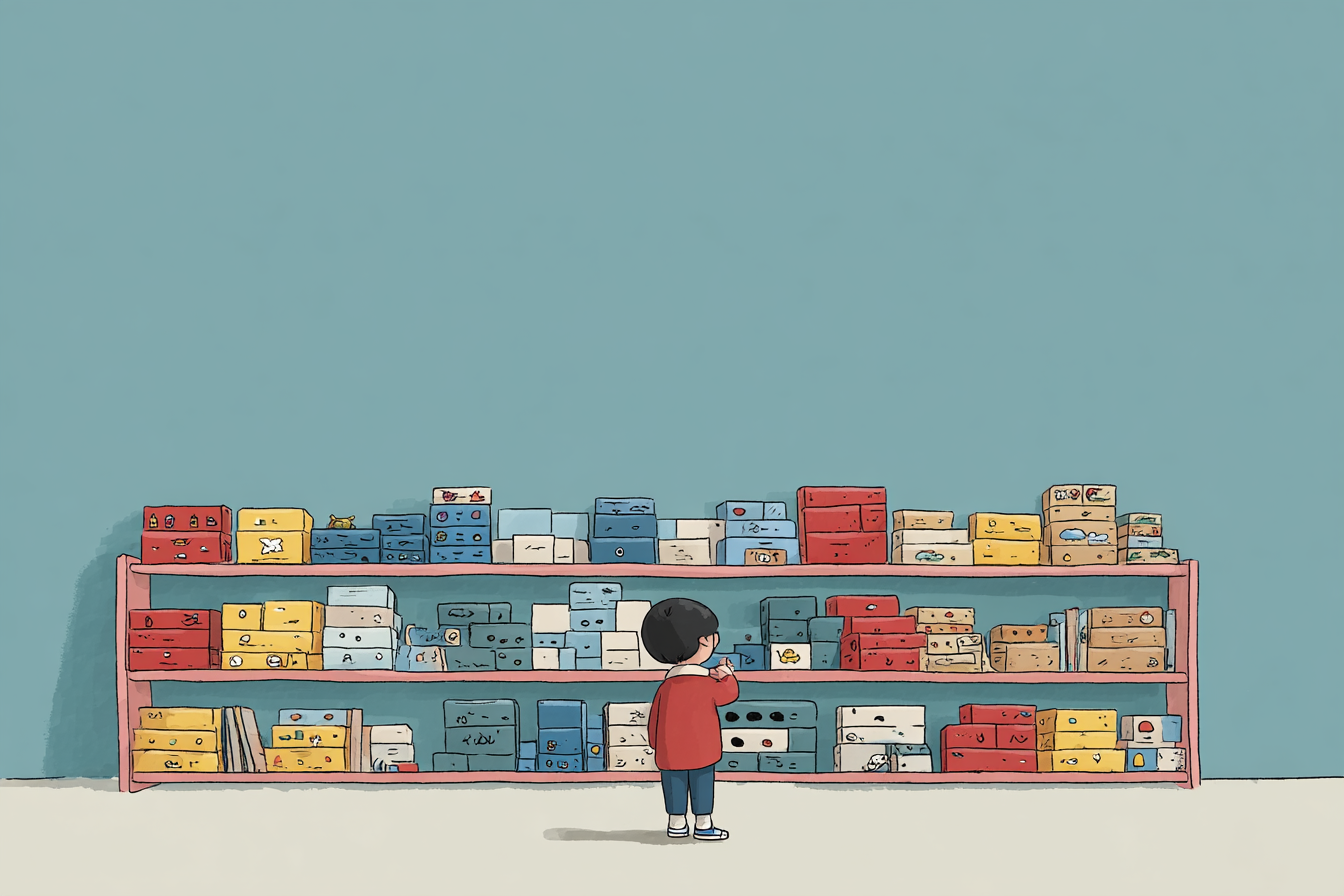
My 3-year-old can stay with one airport game for a long time. He assigns gates. Moves planes. Rearranges the same little world until it starts to look like a system. Leave twelve different toys out and the whole thing changes. He bounces. Samples. Drifts. Nothing gets enough attention to become interesting or educational.
That is easy to misread as a child problem.
Most of the time it is an environment problem.
Too many toys is not neutral
When adults see a room full of options, we see abundance.
Toddlers often experience it as interruption.
Every visible toy is a fresh bid for attention. Every color, shape, and unfinished possibility competes with the thing they were already doing. If you want deep play, the environment has to stop heckling.
That does not mean empty rooms or minimalist performance art. It means curation.
A good play setup makes the next useful move easier to see.
Why this matters for STEM and computational thinking
A lot of early STEM marketing focuses on the toy itself. The robot. The subscription box. The coding game. The sensory kit with twelve different “learning modes.”
But the habits underneath early STEM usually do not start with the branded product.
They start when a child has enough uninterrupted attention to notice structure.
That looks like:
- sorting vehicles by function
- deciding which block should support the bridge
- repeating a pretend game with one rule changed
- debugging a marble run after it collapses
- building categories inside imaginative play
Those habits depend on focus more than novelty.
The parent-developer instinct is useful here
If you build software, you already know the pattern.
Systems fail when everything asks for attention at once.
Good products do not surface every possible feature on one screen.
A toddler playroom works the same way.
You are not trying to maximize what is available. You are trying to make one useful path obvious.
That means a better question than “what toy should I buy?” is often “what should I put away?”
What to do instead of buying more
Here is the simple version.
1. Rotate instead of stacking
Do not leave every toy visible all the time.
Keep a smaller active set out for the week and store the rest. Rotation creates novelty without flooding the room.
2. Group toys by logic, not by storage bin
If your child is deep in airports, put the planes, vehicles, tape, books, and small props nearby.
You are building one problem space, not a catalog.
3. Clear a real work surface
Toddlers do better when there is an obvious place to build, sort, line up, and test ideas.
A clear patch of floor or table does more for early STEM than another flashy gadget.
4. Watch what survives after lunch
A good activity is not the one that photographs well at 9 AM.
It is the one your child comes back to later.
Obsession is signal.
5. Protect unfinished work
If your toddler builds an airport, road, or sorting setup, leave it up when you can.
Returning to a system is how children deepen it.
You do not need a better toy first
You might need less interference.
One hopeful part of this is that you usually do not need better stuff. A toddler with time, space, and one decent setup will often do more real thinking than a toddler being handed the next “educational” thing every fifteen minutes.
Toddlers are not bad at focus.
If the room is noisy, they show you.
If the setup is coherent, they show you that too.